Packaging & labels
JML White Label AC Artwork: What Is Actually Printed on the Box
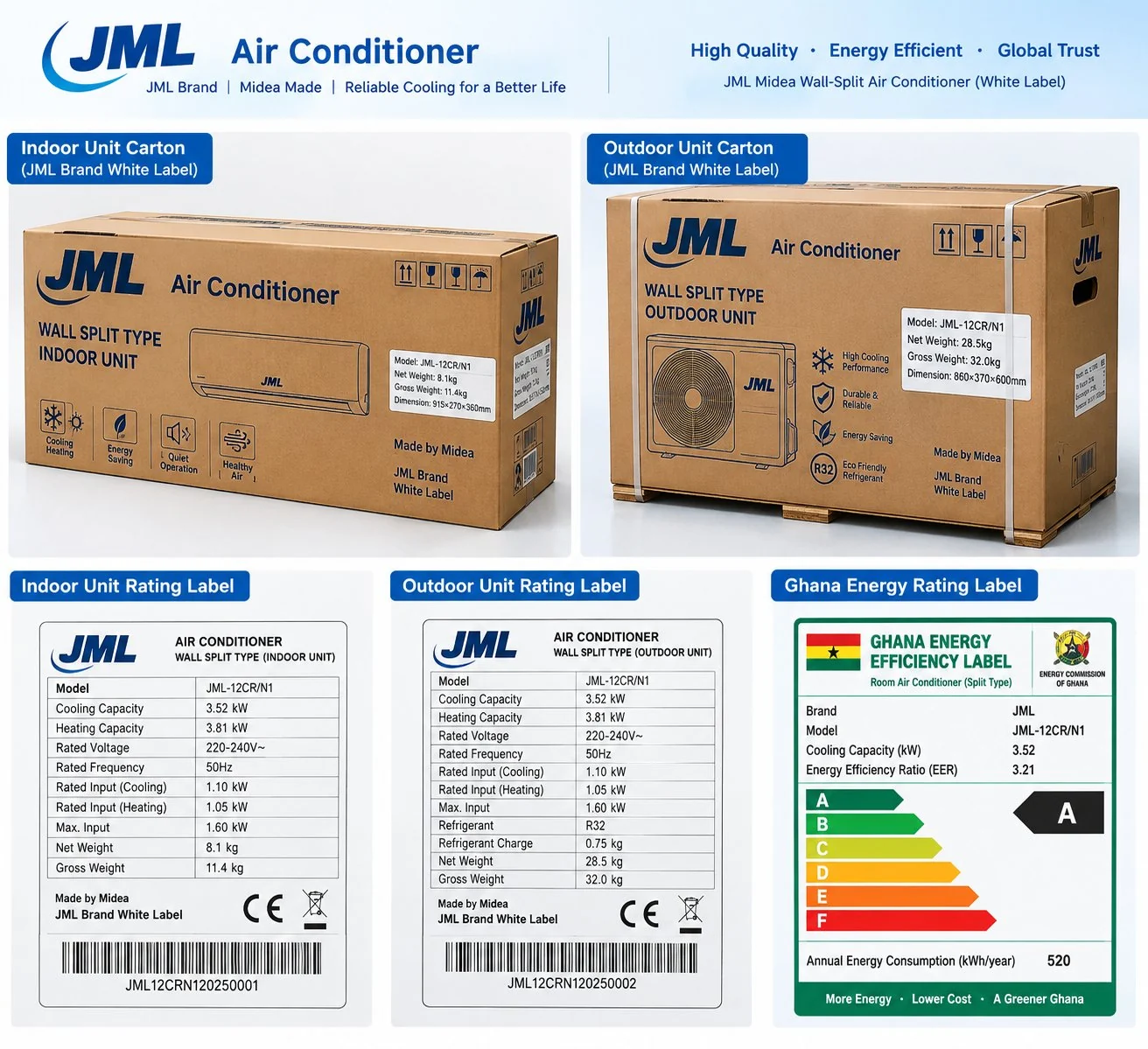
Product renders sell a feeling. Carton marking and a rating label settle a deal. This page shows the genuine production artwork for JML-12CR/N1 — a fixed-speed 12,000 BTU wall split supplied as JML White Label — exactly as it comes off the press: indoor carton, outdoor carton, both rating labels, and the Ghana Energy Commission efficiency label. Every number below was read directly from the printed artwork. Nothing here is a mock-up, and nothing is rounded up for presentation.
Why the artwork matters more than a product photo
A glossy product shot tells you what a unit looks like. The carton and the nameplate tell you whether you can actually sell it, clear it, and service it. Three people look at this artwork for three different reasons, and all three are your problem if it is wrong.
The customs broker reads the rating label. To import air conditioners into Ghana, the clearing process wants the model code, rated voltage, frequency, refrigerant type and charge, and the manufacturer name to line up with the commercial invoice and the packing list. When they do not line up, the container sits. Storage accrues. The importer pays for a paperwork problem they did not create.
Your warehouse and freight forwarder read the carton. Net weight and gross weight decide how the load is built, how many sets go in a 40′ HQ, and what the inland haulage will cost from Tema to Kumasi or Accra. Carton dimensions determine pallet maths and how you stack without crushing the units inside.
Your customer and your technician read both. When a unit comes back six months later, the model code on the rating label is what matches the unit to the right spare part, the right wiring diagram, and the right remote. A label that does not match the box it shipped in turns a five-minute parts lookup into a lost sale.
Here is the practical value of a real photo rather than a render: it is checkable. You can hold it next to the container that arrives, compare the model code, the weights, the refrigerant charge and the barcode, and know in two minutes whether you got what you paid for.
Treat the artwork as a specification document, not marketing. It is the first thing your broker reads and the last thing your service tech will look at.
Indoor unit carton
The indoor carton carries the JML identity, the unit type, and the four selling icons a retail buyer actually scans for: Cooling/Heating, Energy Saving, Quiet Operation and Healthy Air. The marking block on the side panel is where the freight numbers live, and this is the block your forwarder will want photographed before booking.
| Model | JML-12CR/N1 |
|---|---|
| Printed description | WALL SPLIT TYPE INDOOR UNIT |
| Net weight | 8.1 kg |
| Gross weight | 11.4 kg |
| Dimension | 915 × 270 × 360 mm |
| Brand panel | JML Brand White Label |
| Manufacturer line | Made by Midea |
| Feature icons | Cooling/Heating · Energy Saving · Quiet Operation · Healthy Air |
Why the two weights matter. The 8.1 kg net figure is the unit and its accessories. The 11.4 kg gross figure is what you actually lift — unit, foam, carton, bagged accessories and documentation. That 3.3 kg gap is packaging, and it is the number that goes into your freight calculation. A forwarder quoting on net weight will under-quote your container.
Why 915 × 270 × 360 mm matters. It is a long, shallow carton. Two units of this size will not stack flush against an outdoor carton at 860 × 370 × 600 mm, which is why loading is done as matched indoor/outdoor pairs rather than as independent carton stacks. Plan your 40′ HQ on sets, not on individual cartons — 366 sets of the 12K split is the working figure for this cabinet.
The four icons are printed claims about the unit's features. They are not certifications. The markings that carry regulatory weight on this box are "Made by Midea", the model code, and the weights.
Outdoor unit carton
The outdoor carton is the heavy one, and it carries the specification that ends arguments with customers: the refrigerant.
| Model | JML-12CR/N1 |
|---|---|
| Printed description | WALL SPLIT TYPE OUTDOOR UNIT |
| Net weight | 28.5 kg |
| Gross weight | 32.0 kg |
| Dimension | 860 × 370 × 600 mm |
| Refrigerant | R32 |
| Brand panel | JML Brand White Label |
| Manufacturer line | Made by Midea |
| Feature icons | High Cooling Performance · Durable & Reliable · Energy Saving · R32 Eco Friendly Refrigerant |
The R32 icon is the commercially interesting one — and the label confirms the R32 refrigerant charge. R32 has a global warming potential of 675, roughly a third of R410A's. For a buyer in a market where refrigerant regulation is tightening, that is the least controversial choice you can make in a fixed-speed unit. It is also a technical decision that affects your service business: R32 runs at higher pressure than R410A and is mildly flammable (A2L), so a technician topping up a system needs the right equipment and the right training. Stocking R32-only units means one set of tools, one spare-parts logic, and one safety briefing for your field team.
The weight class tells you the logistics story. At 32.0 kg gross, the outdoor carton is nearly three times the indoor parcel. Outdoor units carry the compressor, the condenser coil and the refrigerant charge, so they dominate both your freight bill and your manual-handling risk. Two workers, or a trolley — not one porter carrying it on his shoulder across a market.
"Durable & Reliable" and "High Cooling Performance" are manufacturer descriptors. They are not test results. If your customer wants proof, the document that answers them is the rating label, not the carton graphic.
Reading the rating labels
Two labels, one system. The indoor and outdoor labels describe the same matched pair, and reading them together is how you confirm you have received a set rather than two mismatched halves. Everything below is the unit's nameplate data, transcribed as printed.
| Model | JML-12CR/N1 |
|---|---|
| Cooling capacity | 3.52 kW |
| Heating capacity | 3.81 kW |
| Rated voltage | 220–240 V~ |
| Rated frequency | 50 Hz |
| Rated input (cooling) | 1.10 kW |
| Rated input (heating) | 1.05 kW |
| Max. input | 1.60 kW |
| Refrigerant / charge | R32 · 0.75 kg (outdoor label) |
| Net weight — indoor / outdoor | 8.1 kg / 28.5 kg |
| Gross weight — indoor / outdoor | 11.4 kg / 32.0 kg |
| Markings | Made by Midea · JML Brand White Label · CE |
| Barcode — indoor / outdoor | JML12CRN120250001 / JML12CRN120250002 |
How to read the electrical data like a buyer. Rated input cooling of 1.10 kW is the steady-state draw. Max. input of 1.60 kW is the figure you size your circuit on — it accounts for compressor start-up and the worst-case operating point. If your electrician cables to 1.10 kW, the breaker will trip on a hot afternoon. Specify for 1.60 kW and you are covered.
Net weight vs gross weight, side by side. This is the single most misread pair on the sheet. Net weight is the equipment; gross weight is the shipment. For the 12K, the indoor unit runs 8.1 kg net against 11.4 kg gross, and the outdoor unit runs 28.5 kg net against 32.0 kg gross — a complete set is 36.6 kg net and 43.4 kg gross. Quote freight and haulage on the gross figures, and confirm the net figures against the model code before you sign for a container.
Why 220–240 V / 50 Hz is stated as a range. It matches the West African grid, which in practice drifts above and below nominal. Equipment built only for a tight 230 V band will misbehave in a market that swings to 250 V on a light load and sags under heavy air-conditioning demand. A 220–240 V rating is the practical tolerance you want.
The 12,000 BTU arithmetic. A nominal 12,000 BTU/h unit is usually quoted as 3.5 kW of cooling. This artwork states 3.52 kW rated cooling — the actual tested figure, slightly above nominal. That is a detail worth knowing when a competitor's sheet says 3.50 kW and a customer asks why yours looks different.
The CE mark appears on both labels. It is the manufacturer's declaration of conformity with applicable EU requirements. It is not a Ghanaian or Nigerian market approval, and it is not a substitute for the conformity certificates your broker will ask for at Tema or Tin Can. The only market-specific regulatory label in this artwork is the Ghana one, described next.
The Ghana Energy Rating Label
This is the label that does the most commercial work, and it is the one buyers most often misread. The Ghana energy efficiency label is issued under the Energy Commission of Ghana framework, which requires air conditioners offered for sale in Ghana to carry an efficiency label showing the model, cooling capacity, efficiency ratio and annual energy consumption. If your shipment arrives without it, you have a selling problem, not just a compliance one.
| Issuing authority | Energy Commission of Ghana |
|---|---|
| Brand | JML |
| Model | JML-12CR/N1 |
| Cooling capacity | 3.52 kW |
| Energy Efficiency Ratio (EER) | 3.21 |
| Energy efficiency grade | A (scale A to F) |
| Annual energy consumption | 520 kWh/year |
| Tagline | More Energy · Lower Cost · A Greener Ghana |
What an EER of 3.21 actually means. EER is cooling output divided by electrical input, in the same units — so 3.52 kW of cooling for 1.10 kW of power gives you 3.20, and the label rounds the measured value to 3.21. In plain terms: for every 1 kW of electricity you pay for, you get about 3.2 kW of cooling. That is the honest, unglamorous figure for a fixed-speed machine.
What 520 kWh/year means for your customer. The annual consumption figure is a modelled estimate based on a standard usage profile, not a promise about your customer's actual bill. It is the number to quote when a shop owner asks what the unit costs to run. For comparison shopping between two A-rated units of the same capacity, the kWh/year figure is more useful than the letter grade, because the letter band is wide and two A-rated products can still differ.
Read the grade in context. An A grade on this label means the model met the efficiency band the Energy Commission applied when it was registered. It is a market-access statement. It is not a claim that this is the most efficient air conditioner available, and we would not present it as one — a fixed-speed ON-OFF unit is a different product category from a variable-speed machine, and they should not be compared on this label alone.
Why we publish the number rather than hiding it. Plenty of sellers in the region print an energy label with no testable figure behind it. JML-12CR/N1's label carries a specific EER and a specific annual consumption figure, which means you can hand this page to a customer, a broker or a competitor and let them check it against the artwork on the box. A buyer who can verify a number is a buyer who stops asking awkward questions.
Verify it yourself. Every figure on this page is legible on the production artwork. Ask us for the full-resolution file for the model you are importing, and check the EER line and the barcode against the container when it lands.
Barcode & traceability
The two labels carry sequential serial numbers, and that sequencing is not decorative. It is the mechanism that keeps an indoor half and an outdoor half together as one sellable set.
How to read the structure. The string breaks down as the model family (JML12CRN1 — JML, 12K, cooling and reverse-cycle, series N1), a production reference (2025), and a per-unit sequence (0001, 0002). Every unit in a container carries a unique number, which means a specific indoor unit can be traced back to the outdoor unit it was pressure-tested and packed with.
Why this matters in practice. First, warranty claims: when a customer returns a unit, the serial on the rating label is what you quote to identify the batch and the production window. Without it, a claim is an argument; with it, a claim is a lookup. Second, set matching in your warehouse: indoor and outdoor units are packed and shipped as pairs, but they get separated in a busy store, and consecutive serials let your team re-match halves correctly instead of pairing a 12K indoor unit with whatever outdoor unit is nearest the door. Third, container reconciliation: counting cartons tells you how many pieces arrived, but scanning serials tells you whether the right pieces arrived and whether a set is missing only its outdoor unit. On a 366-set container, that distinction is the difference between a clean receipt and a claim against the carrier.
Photograph the serial block on every unit during receiving, before the containers are broken down. It costs your team a few hours and it settles most disputes later.
What "White Label" actually means on these boxes
Look at the marking block on either carton or either rating label, and you will see the same two lines: Made by Midea, and JML Brand White Label. Both lines are doing precise work, and the difference between them is the whole business model.
"Made by Midea" is a manufacturing statement. It says the unit was built in a Midea production facility. It is a statement about the factory, not about the brand on the front panel. To be unambiguous about this: JML is not a Midea distributor, dealer or authorised reseller, and these are not Midea-branded units. JML supplies Midea-manufactured equipment under its own brand — which is exactly what the second line says.
"JML Brand White Label" is a channel statement. It says the unit is sold under the JML brand, ready to sell as it arrives, with JML artwork, JML cartons and JML documentation. In other words, the whole white label air conditioner packaging job is already done for you. You do not need to commission artwork, register a brand, or wait for a print run. Unbox, price, sell.
Why that combination is useful to a West African buyer. It gives you a defensible quality claim (Tier-1 OEM-manufactured, built by Midea) without asking you to build a brand first. It also gives you a clean answer when a customer asks who actually makes the unit — you point at the carton, and the carton says "Made by Midea".
And if you want your own name on the box? This is where the two supply models diverge. Under Private Label OEM, that same marking block changes:
| Marking line | JML White Label | Private Label OEM |
|---|---|---|
| Brand block | JML Brand White Label | Your brand name |
| Carton graphics | JML artwork | Your artwork |
| Rating label brand field | JML | Your brand |
| Manufacturer line | Made by Midea | Made by Midea (unchanged) |
| MOQ basis | By model, no artwork setup | By model, artwork sampling required |
The "Made by Midea" line does not change under either model, because it is a fact about the factory. The brand block does change, because it is a fact about you. That is the entire difference between buying a ready-to-sell JML White Label line and commissioning your own private-label AC brand — and it is a decision you can make per model, not for your whole business at once.
Ready to supply your shop with Tier-1 OEM-manufactured AC?
Chat with JML on WhatsApp or request your dealer price.
CHAT ON WHATSAPP