News & guides
How to Import Air Conditioners from China: West Africa Guide
19 September 2026 · JML Market Team
Why West African Buyers Source AC from China
If your container of air conditioners gets stuck at the port for six weeks, or your customers complain that the units will not switch on during a power dip, the problem almost always started with a sourcing decision made in Guangdong, not at the wharf in Lagos or Abidjan. Learning how to import air conditioners from China the right way is the single biggest leverage a West African AC wholesaler, retailer, or importer has in 2026: it can cut your landed cost by 30 to 50 percent versus buying through regional middlemen, but only if you get the brand, the specs, the certification, and the supplier verification right before a single dollar leaves your account.
You are not alone in asking this question. In the 2025 fiscal year, China's home air-conditioner exports to Africa grew 17.6 percent year on year, even as exports to North America fell 12.2 percent. Africa now has 1.4 billion people with a median age under 20, and air conditioning is moving from luxury to necessity across Nigeria, Ghana, Senegal, Cote d'Ivoire, Benin, and Togo. Chinese factories make the overwhelming majority of the world's room ACs, which is exactly why importers from Dakar to Lagos are flying to the Canton Fair.
Three forces push West African buyers toward Chinese supply. First, brand dominance: Chinese air conditioner brands account for the bulk of global room-AC production, and Chinese OEM factories supply dozens of foreign brands already on West African shelves. The manufacturing ecosystem, from compressors and coils to plastics and electronics, is concentrated in Guangdong and adjacent provinces, which means shorter lead times and deeper technical bench strength than almost anywhere else. Second, price-to-performance: a tropical-grade split system from a tier-1 Chinese line costs a fraction of a comparable Japanese or Korean unit, with reliability that has improved dramatically over the past decade. Midea signed on as an official sponsor of the TotalEnergies 2025 Africa Cup of Nations, and the major brands are building local assembly in Egypt, so the supply side is firmly pointed at Africa. Third, rising African demand: Africa's GDP is forecast at 3.9 percent in 2025 and about 4 percent in 2026, and urbanization with heatwaves keeps cooling demand climbing. For a wholesaler, the strategic question is no longer whether to source from China, but how to do it without losing a container to customs or your reputation to bad units.
Tier-1 Chinese AC Brands & What 'OEM-Manufactured' Really Means
Before you ask for a quote, you need to understand the brand landscape, and one phrase in particular that is easy to misuse. The tier-1 Chinese players include Midea, Gree, Hisense, TCL, and Haier. Midea is the world's largest appliance maker by volume, with deep compressor and inverter know-how. Gree is a pure-play AC champion strong in the Middle East and Africa, holding roughly 17.1 percent of the regional market in 2024 and famed for motor and refrigeration technology. Hisense is aggressive on price and increasingly on cooling, with a fast-growing Africa retail presence. TCL is expanding from TVs into HVAC and is competitive on entry-level splits. Haier brings global white-goods scale and is building African capacity, for example its Egypt eco-park. Most of these names also manufacture for others, which is where Midea-manufactured enters the picture.
Midea-manufactured means the unit was produced inside a Midea-owned or Midea-operated factory, to Midea's engineering and quality systems, but carrying your brand or the supplier's own brand, not the Midea trademark. This is standard OEM/ODM practice: the same production lines, tooling, and quality checks that build Midea-branded goods can build goods for a private-label customer. The product is genuinely Midea-made; it is just not Midea-branded.
Why this matters for you, and the compliance line we never cross. JML is a Midea-manufactured supplier. We are not an authorized Midea distributor or reseller, and we do not sell Midea-branded units. We draw on the former Midea Africa team's manufacturing relationships and 25 years of HVAC experience to supply Midea-built, non-Midea-branded air conditioners, including our GLORY PRO ON-OFF split AC, which is Midea-manufactured and uses R32 refrigerant. We describe ourselves only with facts you can verify: a Midea-manufactured supplier run by the former Midea Africa team, never an authorized reseller trading on a trademark we do not own. That same discipline protects your cash, because we work on a 30 percent deposit with the balance against the bill of lading, not 100 percent prepayment, which is how real factories operate and how fake agents get filtered out. If any listing implies we hold Midea authorization, it is wrong and must be corrected. Never use wording that implies Midea authorization or print the Midea trademark on your cartons.
This distinction matters for you, the importer. Sourcing Midea-manufactured OEM goods lets you capture tier-1 build quality under your own brand or a neutral brand, without implying any trademark license you do not hold. It keeps you, and your supplier, on the right side of intellectual-property and advertising law in every market you sell into. When you evaluate a Midea OEM air conditioner supplier, ask directly: are these Midea-manufactured, and will they ship without the Midea trademark? A trustworthy answer protects your business.
Private Label vs White Label vs Branded: Which Model Fits You
Most new importers confuse three words that change your margin, your risk, and your future equity. Branded, also called OBM, means you resell an established name such as Midea or Gree. It brings the highest trust but the lowest margin for you, and you need distribution rights you may not have. White label is a finished, unbranded unit you stick your logo on. It is fast to launch and needs zero engineering, but anyone can copy it. Private label, also called OEM-ODM, means you co-develop specs, voltage, tropical rating, cosmetics, and carton, with the factory. It is more work, but you own a differentiated product and the customer relationship.
JML runs a dual model. We supply Midea-manufactured units you can take as white label, our GLORY PRO line, ready to go, or develop as a private label tuned to your market with T3 tropical rating, R32 refrigerant, low-voltage startup, and French or English cartons. Our Midea OEM and ODM private-label service locks your spec across every reorder. For a first-time West Africa AC wholesale buyer, white label de-risks the launch; for a wholesaler with volumes, private label builds a brand Nigerians or Senegalese recognize and reorder.
A wholesaler in Accra we will call Kwame started in 2023 buying generic splits from a trading company. Margins were thin and two competitors sold the identical box. In 2024 he shifted to a Midea-manufactured private-label split with his own name, T3 rating, and a French and English manual. Within two selling seasons his brand was the one installers asked for by name, and his reorder price held even as freight rose, because the factory treated his tooling as a locked spec.
How to Verify a Reliable Chinese AC Supplier
Scams in AC sourcing are real, from fake factories and phantom certifications to agents who vanish after a 100 percent prepayment. Here is how serious Chinese AC suppliers for West Africa prove themselves. First, audit the factory or pay for one. Use a third-party inspection firm such as SGS, TUV, or a local Guangdong auditor for a pre-shipment and factory audit. Confirm they own the line, not just a showroom, and ask for the production address and a live video walkthrough.
Second, check export records. A real exporter can show you bill-of-lading references, container photos from past West Africa shipments, and CE or CB test reports. Vague answers are a red flag. Third, never pay 100 percent upfront. The industry norm is about 30 percent deposit against a proforma invoice, with the balance against a copy of the bill of lading. Anyone demanding full prepayment before production is a warning sign. Fourth, validate the certificate chain: for Nigeria-bound goods, confirm the supplier can support SONCAP with test reports to IEC and SON standards; for R32 units, they must provide an MSDS and a dangerous-goods declaration. Fifth, talk to references, because a solid supplier will connect you with another African importer, and one reference call saves more than ten email exchanges.
A first-time importer in Lome found a factory on a classified site offering split ACs 25 percent below market with pay-all-now terms. He wired the full amount. The tracking number never updated and the sales manager stopped replying after day ten. The lesson his association now teaches is simple: if the price looks impossible and the payment terms are all-upfront, the only thing being imported is your money out of the country.
Must-Have Specs for West Africa: 230V/50Hz, T3 Tropical, R32, Low-Voltage Startup
This is where containers of cheap units become expensive mistakes, because West African grids are not Chinese or European grids. Voltage and frequency must be 220 to 240V at 50Hz. Nigeria, Ghana, and the ECOWAS bloc run on 230V/50Hz. A 220V unit is fine; a 110V North-American spec is useless here.
Specify a T3 tropical rating. The unit must cool reliably when ambient temperatures exceed 35C, often 43 to 52C in a West African heatwave. A standard T1 unit will trip or lose capacity. Also specify low-voltage startup: grids sag, so choose a unit that can start and run at roughly 135V, with some designs claiming down to 130V. This single feature prevents the it will not turn on during the evening dip complaints that destroy retailer trust. Refrigerant should be R32, now the efficient, lower-GWP standard that certification bodies expect. Note that R32 is mildly flammable, so sea freight requires an MSDS and dangerous-goods declaration. Build that into your plan.
Coastal cities such as Lagos, Dakar, Abidjan, and Cotonou are corrosive, so ask for anti-corrosion blue fins or gold fins on the condenser. Finally, match the carton and manual language to your market, English, French, or both. You can browse split and inverter systems built to these exact specs in our Midea-manufactured AC range.
MOQ, Pricing & Incoterms: What a Wholesale Order Really Costs
A cheap unit price is the smallest part of your real cost. Minimum order quantity for split ACs is a full container: a 40-foot high-cube typically holds 200 to 400 units depending on BTU size, with smaller 9K to 12K BTU units packing more and 24K to 36K fewer. Mixing BTU sizes in one container is usually possible, so confirm the mix ratio with the factory.
Incoterms decide who pays for what. Ex works, or EXW, means you collect from the factory gate: the cheapest headline price but the most responsibility on you. Free on board, or FOB, means the supplier delivers to the Chinese port and loads the container, while you pay ocean freight, insurance, and destination costs, which is the most common term for experienced importers. Cost, insurance, freight, or CIF, means the supplier pays to your destination port: easier, but you pay a markup and lose control of the freight. Delivered duty paid, or DDP, means the supplier handles everything to your door including duties: simplest and most expensive, and only safe if the supplier truly understands your country's clearance.
Your true unit cost is the FOB price plus ocean freight, insurance, destination handling, customs duty, VAT, clearance and agent fees, last-mile trucking, and an after-sales buffer. A unit at 120 dollars FOB can land at 190 to 230 dollars all-in depending on country and container size. Model this on a spreadsheet before you quote customers. If you want real numbers instead of guesses, request a West Africa AC quote and we will return a FOB-based landed-cost estimate for your target countries and volumes.
Customs, Certification & Clearance by Country
Clearance is where margins die or deals ship. Nigeria runs the SONCAP program, the Standards Organisation of Nigeria Conformity Assessment Programme. For air conditioners under HS 8415 it is a two-step process. First, the Product Certificate, or PC, is model-specific, valid about one year, and based on test reports to IEC and SON 60335-1; apply before you ship. Second, the SONCAP Certificate, or SC, is issued per shipment against a valid PC using the proforma invoice and packing list, and it is the document customs demands at the port. Under 2025 updates, SON moved to an electronic certificate system integrated with customs, which cuts forgery and speeds clearance. Air conditioners also need MEPS energy-efficiency labels at levels 1 to 5 and must be 230V/50Hz compatible with UK-style BS 1363 plugs. Your Nigerian importer must complete CRIA registration, a unique importer ID, before the SC is issued. Plan four to six weeks for first-time PC testing.
A Kano-based importer pre-arranged his PC in March and had his SC issued before the vessel left Shenzhen. Because the documents matched the bill of lading exactly and the cartons carried SONCAP Certified with his address, Lagos cleared the container in under 72 hours. His competitor, who treated SONCAP as something the agent fixes later, waited 41 days and paid demurrage that erased his margin.
Ghana uses the Ghana Standards Authority and a destination inspection regime. Importers need conformance documentation and accurate valuation, the air conditioner HS code 8415 must be declared precisely, and you should budget for duty plus NHIL and VAT. Pre-clearance and a good clearing agent in Tema save weeks. The French-speaking markets, Senegal, Cote d'Ivoire, Benin, and Togo, sit inside the ECOWAS Common External Tariff, with UEMOA customs-union alignment for Cote d'Ivoire, Benin, and Togo. Room ACs generally fall in the highest CET band at about 20 percent, with VAT around 18 percent in Senegal and Cote d'Ivoire. Documents must be in French, the commercial invoice, the packing list, and the certificate of origin, and a supplier who cannot produce French paperwork will cost you at the customs office. For Cote d'Ivoire, Abidjan is a major hub; expect CET duty, VAT, and possibly a statistical or community levy, plus a conformance mark and French labels where applicable.
Shipping & Logistics: FCL/LCL, Lead Times, French-West-Africa Notes
A full container load, FCL, is cheaper per unit and lower-risk. Less-than-container load, LCL, lets you test the market with a few pallets but exposes goods to other shippers' damage and slower handling. For a first trial, LCL to Tema or Abidjan is reasonable; for real volume, FCL in a 40-foot high-cube.
Lead times run from South China to Dakar at about 22 to 28 days by sea, to Lagos or Apapa at roughly 28 to 35 days, and to Abidjan or Tema in similar West-Africa windows. Add one to two weeks for production and another for clearance. Buyers who import air conditioners from China at scale build these windows into their sales calendar so they never miss the hot season.
For Senegal, Cote d'Ivoire, Benin, and Togo, insist on French commercial documents, the correct HS code 8415 with a clean description, and a pre-booked clearing agent who speaks French and knows customs procedure. Because R32 is mildly flammable, the booking needs an MSDS and dangerous-goods form; some carriers restrict it, so confirm at booking, not at the terminal.
Spare Parts, Warranty & After-Sales
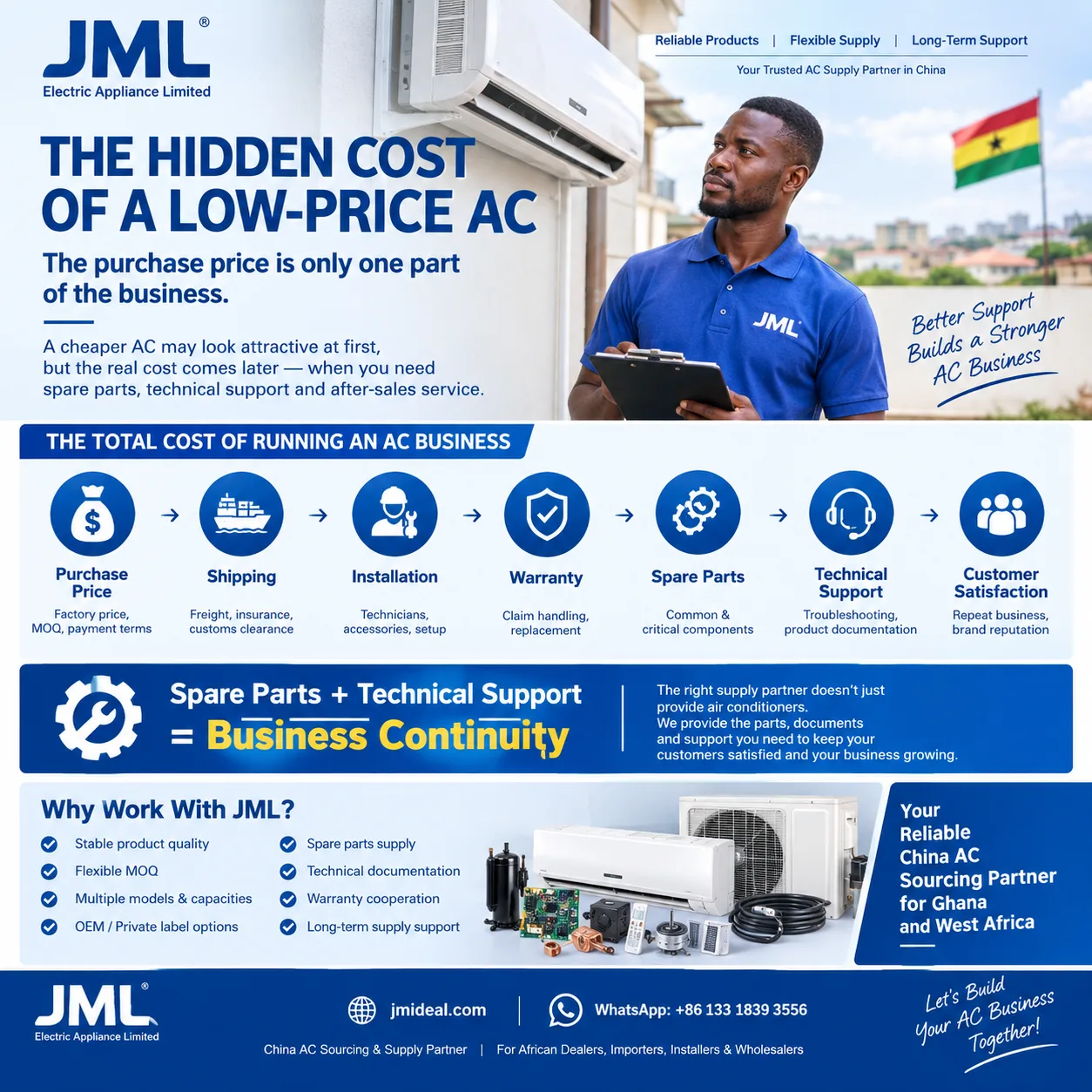
The sale closes at the port, but the business is won in the field. West African buyers reorder from suppliers who plan after-sales. Order a spare-parts kit, a percentage of compressors, PCBs, remotes, and installation kits alongside the units, for example 2 to 3 percent of line value. A wholesaler who can ship a replacement board in three days keeps the retailer loyal.
Define warranty terms in writing: a compressor warranty, often 3 to 5 years on Midea-manufactured lines, versus one year on parts, printed on the carton and manual. Use bilingual manuals, English for Nigeria and Ghana, French for Senegal, Cote d'Ivoire, Benin, and Togo, because a manual only in Chinese is a return waiting to happen. List authorized repair points in your market and train two or three installers per city. JML supports spare-parts planning and supplies both English and French manuals with its Midea-manufactured range, because a unit that cannot be serviced is a unit you will be asked to replace for free.
Nigeria: Import & Clearance
Nigeria clears air conditioners through the port of Lagos, including Apapa and Lekki. The core certification is SONCAP, the Standards Organisation of Nigeria Conformity Assessment Programme, requiring both a Product Certificate, or PC, and a SONCAP Certificate, or SC, plus a MEPS energy-efficiency label at levels 1 to 5 and CRIA importer registration. Units must be 230V/50Hz with UK-style BS 1363 plugs.
The common pain point is an SC-to-bill-of-lading mismatch, where a typo in value, model, or quantity can cost weeks of delay, so file the SC before the vessel sails and match every field to the B/L. Plan four to six weeks for first-time PC testing.
Ghana: Import & Clearance
Ghana clears through the port of Tema under the Ghana Standards Authority and a destination inspection regime. The core requirement is conformance documentation with accurate valuation, and the air conditioner HS code 8415 must be declared precisely. Budget for import duty plus NHIL and VAT.
The common pain point is valuation disputes at Tema, so pre-clearance and a good clearing agent in Tema save weeks and prevent surprises at the border.
Senegal: Import & Clearance
Senegal clears through the port of Dakar inside the ECOWAS Common External Tariff and the UEMOA customs union. The core requirement is French-language documentation, the commercial invoice, packing list, and certificate of origin, because a supplier who cannot produce French paperwork will cost you at the customs office. Expect the highest CET band at about 20 percent plus VAT around 18 percent.
The common pain point is French paperwork gaps, so insist your supplier delivers a facture commerciale, a liste de colisage, and French labels before the container sails.
Cote d'Ivoire: Import & Clearance
Cote d'Ivoire clears through the port of Abidjan, a major West African hub, inside the ECOWAS Common External Tariff and UEMOA alignment. The core requirement is French-language documents and a conformance mark where applicable, with the air conditioner HS code 8415 declared precisely. Expect about 20 percent CET duty plus VAT around 18 percent, and possibly a statistical or community levy.
The common pain point is port congestion at peak season, so book your clearing agent early and pre-stage every French document to keep the container moving.
Benin: Import & Clearance
Benin clears through the port of Cotonou inside the ECOWAS Common External Tariff and UEMOA alignment. The core requirement is French-language documentation, the commercial invoice, packing list, and certificate of origin, with HS code 8415 declared precisely. Expect about 20 percent CET duty plus VAT.
The common pain point is transit cargo controls, so keep your paperwork consistent and work with a clearing agent who knows the Cotonou transit rules.
Togo: Import & Clearance
Togo clears through the port of Lome inside the ECOWAS Common External Tariff and UEMOA alignment. The core requirement is French-language documentation with the air conditioner HS code 8415 declared precisely. Expect about 20 percent CET duty plus VAT.
The common pain point is small-port handling limits, so plan for slower throughput and pre-book your clearing agent and French documents before arrival.
7 Mistakes That Get Your Container Seized
Avoid these seven mistakes and you avoid the horror stories. First, the wrong HS code: declaring a heat pump as a cool-only unit, or misclassifying parts, triggers re-assessment and penalties, so match the code to the product. Second, a missing R32 MSDS: R32 is a dangerous good, and no MSDS with a dangerous-goods declaration means the booking is rejected or the container is held.
Third, a label mismatch: cartons without SONCAP Certified for Nigeria, or without the importer's address, fail inspection. Fourth, an SC-to-B/L mismatch: the SONCAP SC must match the bill of lading exactly in value, model, and quantity, and a typo costs weeks. Fifth, the wrong voltage: shipping 110V or 60Hz units to a 230V/50Hz market means dead stock. Sixth, no tropical rating: T1 units in T3 heat trip and get returned, and your retailer stops reordering. Seventh, paying 100 percent upfront to an unverified factory, the fastest way to import nothing but a loss, so verify first.
Frequently Asked Questions
Q: How do I import air conditioners from China to West Africa? A: The short path is to pick tier-1 or Midea-manufactured supply, confirm tropical specs of 220 to 240V/50Hz, T3, R32, and low-voltage startup, verify the factory, lock a 30 percent deposit plus bill-of-lading-balance contract, handle certification such as SONCAP for Nigeria and ECOWAS CET with French docs for the Francophone four, then ship FCL and clear with a local agent. This way you control cost and compliance instead of gambling on a trading-company deal.
Q: What does Midea-manufactured mean, and are you an authorized Midea distributor? A: Midea-manufactured means the unit is built inside a Midea factory to Midea's engineering and quality systems, but carries your brand or ours, not the Midea trademark. We are not an authorized Midea distributor or reseller, and we do not sell Midea-branded units. JML is a Midea-manufactured supplier run by the former Midea Africa team, so you get tier-1 build quality without any trademark claim you do not hold.
Q: Do I need SONCAP to import air conditioners into Nigeria? A: Yes. Nigeria requires SONCAP for air conditioners under HS 8415. It is a two-step process: first obtain a Product Certificate for the model, valid about one year and based on IEC and SON test reports, then a SONCAP Certificate per shipment against that PC. The SC is the document customs demands at the port, so file it before the vessel sails.
Q: What is the MOQ for a private-label or white-label AC order? A: For our GLORY PRO ON-OFF split AC and similar Midea-manufactured lines, a full 40-foot high-cube container is the efficient minimum, holding roughly 200 to 400 units depending on BTU size. Smaller trials are possible via LCL, but a 40'HQ mix is the typical starting point for a private-label or white-label program.
Q: Which specifications matter most for West Africa? A: Four things decide whether your units sell or get returned: 220 to 240V/50Hz, not 110V/60Hz; a T3 tropical rating for 43 to 52C heat; low-voltage startup around 135V; and R32 refrigerant with the MSDS needed for sea freight. Coastal ports also call for anti-corrosion condenser fins.
Get a Quote: Next Steps with a Tier-1 OEM-Manufactured Supplier
You now have the playbook most first-time importers learn the expensive way. The remaining step is to turn this guide into a real, compliant order, starting with a supplier you can verify and a quote you can model. As a Midea-manufactured supplier with the former Midea Africa team and 25 years of HVAC experience, JML helps West African wholesalers, retailers, and importers source tropical-grade, R32, low-voltage-startup split ACs. These are Midea-built, non-Midea-branded units, supplied with English or French manuals and a spare-parts plan. We give you tier-1 manufacturing without the trademark risk, which is exactly why we are not an authorized Midea distributor.
Your next steps are straightforward. Pick your target markets and estimated volumes, with a 40'HQ mix as a good starting point. Confirm specs: 230V/50Hz, T3, R32, low-voltage startup, and coastal fins. Request a West Africa AC quote and tell us your countries, and we return a FOB-based landed-cost estimate and a sample plan. Browse split and inverter systems in our Midea-manufactured AC range, including the GLORY PRO ON-OFF, and shortlist the BTU mix for your market. Lock a 30 percent deposit plus bill-of-lading-copy balance contract, and start your SONCAP and PC early if Nigeria is in scope.
Do not gamble your container on a classified-site factory. Contact our sourcing team for a FOB quote from a verified Midea-manufactured supplier, and import air conditioners from China the way the profitable wholesalers do, compliant, tropical-ready, and built to reorder. Prefer to talk? Chat with our sourcing team on WhatsApp in English or French and get a FOB landed-cost quote for your market within 24 hours. This article is for general guidance; customs rules, tariff bands, and certification procedures change, so confirm current requirements with a licensed customs broker and the relevant standards authority, SON for Nigeria and UEMOA or ECOWAS for the Francophone bloc, before shipping.
Questions about this article?
Ask us directly. We reply on WhatsApp, usually the same business day — short questions are welcome and there is no sales script.
Or type your own question below.