Packaging & labels
Private Label AC Artwork: What Gets Printed on Your Own Branded Box
This is a genuine production artwork, not a mock-up. It belongs to one of our customers — a distributor who sells under their own brand — so we do not repeat that brand name in the text of this page, and the model code is quoted exactly as printed. The unit is a reverse-cycle R32 wall split, 8.80 kW in cooling, built by Midea and sold in the customer's own cartons under their own nameplate. Below: both cartons, both rating labels, the Ghana Energy Commission label, and what each line means for you.
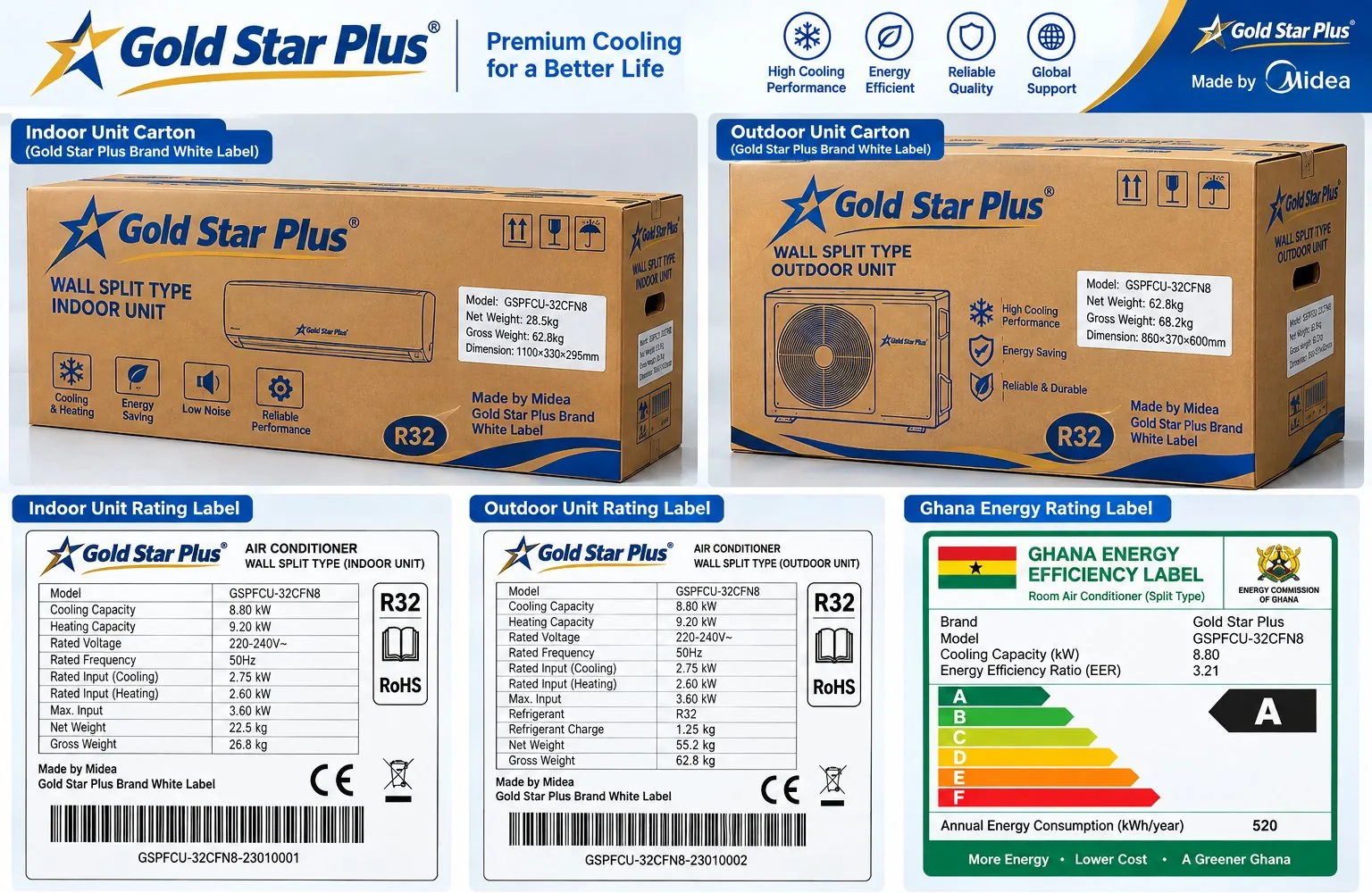
Whose brand is on this box?
Not ours. The brand on this artwork belongs to a customer who placed a private-label order, and that is precisely why it is worth showing: it is what "private label" actually delivers. Anybody can print a logo on a carton. The work sits in the four things underneath — a model code allocated to your brand, a nameplate that carries your brand as an original print rather than a sticker over the factory one, a market energy label issued under your brand, and barcodes that tie each half of a split system back to the half it was packed with. All four are visible in the file above.
We have deliberately kept that customer's brand name out of the text on this page. Their model code, GSPFCU-32CFN8, is quoted exactly as printed, because the model code is what your broker reads, what your warehouse scans and what your technician looks up — a page about label data that hid the label data would be worth nothing to you.
Ask to see the artwork before you pay a deposit. A supplier who cannot produce a completed artwork file for a model they claim to have already made has not, in fact, made it for a brand.
Carton 1 — the indoor unit
| Model | GSPFCU-32CFN8 |
|---|---|
| Printed description | WALL SPLIT TYPE INDOOR UNIT |
| Brand panel | The customer's own brand — white-label line |
| Manufacturer line | Made by Midea |
| Feature icons | Cooling & Heating · Energy Saving · Low Noise · Reliable Performance |
| Refrigerant badge | R32 |
| Marking block | Model · net weight · gross weight · carton dimensions, on the side panel |
The indoor carton is the light one and the one that gets opened in front of a customer, so it does two jobs at once. The four feature icons are the claims a retail buyer scans for in three seconds: does it heat as well as it cools, will it show on the electricity bill, will the bedroom be quiet, will it last. The marking block on the side panel is the freight data — model code, net weight, gross weight and carton dimensions. That is the block your forwarder photographs before booking, and the numbers that decide how the load is built and what inland haulage costs once the container clears Tema.
Those values are locked to the final drawing and confirmed on the packing list for each production run, so take them from the packing list that travels with your own shipment. Packed accessories, documentation and board grade all move gross weight slightly from container to container, and a forwarder quoting off a web page instead of your paperwork will under-quote the haulage.
The four icons are printed feature claims, not certifications. The markings on this carton that carry regulatory weight are "Made by Midea", the model code and the weights.
Carton 2 — the outdoor unit
| Model | GSPFCU-32CFN8 |
|---|---|
| Printed description | WALL SPLIT TYPE OUTDOOR UNIT |
| Brand panel | The customer's own brand — white-label line |
| Manufacturer line | Made by Midea |
| Feature icons | High Cooling Performance · Energy Saving · Reliable & Durable |
| Refrigerant badge | R32 |
| Marking block | Model · net weight · gross weight · carton dimensions, on the side panel |
The outdoor carton is the heavy one, and it carries the specification that ends arguments: the refrigerant. R32 has a global warming potential of 675, roughly a third of R410A, which makes it the least controversial choice available in a market where refrigerant regulation is tightening. It is also a decision that shapes your service business: R32 runs at higher pressure than R410A and is mildly flammable (A2L), so a technician topping up a system needs the matching equipment and training. Stocking R32 only means one set of tools, one spare-parts logic and one safety briefing for your field team.
The weight class tells the logistics story. The outdoor carton carries the compressor, the condenser coil and the refrigerant charge, so it dominates both your freight bill and your manual-handling risk. Plan two people, or a trolley — not one porter carrying the carton on his shoulder across a market.
"Reliable & Durable" and "High Cooling Performance" are manufacturer descriptors, not test results. If your customer wants proof, the document that answers them is the rating label, not the carton graphic.
Reading the two rating labels
Two labels, one system. The indoor and outdoor labels carry the same model code and the same capacity figures because they describe a matched pair — and reading them together is how you confirm you have received a set rather than two mismatched halves. Everything below is nameplate data, transcribed as printed.
| Model | GSPFCU-32CFN8 |
|---|---|
| Cooling capacity | 8.80 kW |
| Heating capacity | 9.20 kW |
| Rated voltage | 220–240 V~ |
| Rated frequency | 50 Hz |
| Rated input (cooling) | 2.75 kW |
| Rated input (heating) | 2.60 kW |
| Max. input | 3.60 kW |
| Refrigerant | R32 |
| Refrigerant charge | 1.25 kg (outdoor label) |
| Markings | Made by Midea · the customer's brand — white label · CE · RoHS · WEEE |
| Barcode — indoor / outdoor | GSPFCU-32CFN8-23010001 / GSPFCU-32CFN8-23010002 |
Rated input versus max. input. 2.75 kW is the steady-state draw in cooling. 3.60 kW is the figure you size the circuit on, because it accounts for compressor start-up and the worst-case operating point. Cable for 2.75 kW and the breaker trips on the hottest afternoon of the year; specify for 3.60 kW and you are covered.
Why the voltage is stated as a range. 220–240 V / 50 Hz matches a grid that drifts in both directions. Equipment built for a tight 230 V band misbehaves in a market that swings to 250 V on a light load and sags when the whole street runs air conditioning.
What 8.80 kW actually is. Roughly 30,000 BTU/h of cooling, with 9.20 kW of heating — a reverse-cycle machine, so it also covers the cold months and the highland nights. A nominal 12,000 BTU unit is around 3.5 kW: this artwork is a different class of equipment, and the capacity spread is what lets one product line cover both a bedroom and a shop floor.
The refrigerant charge is the number your technician needs. 1.25 kg of R32 on the outdoor label is the factory charge. It tells your installer what is in the system, and it is the baseline for any leak diagnosis later.
Both labels also state net and gross weight for each half. Quote freight on gross, confirm net against the model code, and take both from the final drawing and packing list for your own order rather than from a marketing page — this one included.
The CE mark appears on both labels. It is the manufacturer's declaration of conformity with applicable EU requirements — not a Ghanaian or Nigerian market approval, and not a substitute for the conformity certificates your broker will ask for at Tema or Tin Can. RoHS and the crossed-out bin (WEEE) are material and disposal markings.
The Ghana Energy Rating Label
This is the label that does the most commercial work, and the one buyers most often misread. The Ghana energy efficiency label is issued under the Energy Commission of Ghana framework, which requires air conditioners offered for sale in Ghana to carry an efficiency label showing the model, cooling capacity, efficiency ratio and annual energy consumption. A shipment that arrives without it has a selling problem, not just a compliance one.
| Issuing authority | Energy Commission of Ghana |
|---|---|
| Brand | The customer's own registered brand |
| Model | GSPFCU-32CFN8 |
| Cooling capacity | 8.80 kW |
| Energy Efficiency Ratio (EER) | 3.21 |
| Energy efficiency grade | A (scale A to F) |
| Annual energy consumption | 520 kWh/year |
| Tagline | More Energy · Lower Cost · A Greener Ghana |
What an EER of 3.21 means. EER is cooling output divided by electrical input in the same units — 8.80 kW of cooling for 2.75 kW of power is 3.2, and the label states the measured value as 3.21. In plain terms, every 1 kW of electricity you pay for returns about 3.2 kW of cooling. It is the honest, unglamorous figure for this class of machine.
The brand field is the private-label part. On this artwork the brand field reads as the customer's own brand, not the factory's — that is the whole difference between importing a white-label unit and importing your own line. A private-label run normally means the label is issued under your brand, which makes it a pre-shipment step: raise it with your supplier when you confirm the artwork, not after the container lands.
Read the grade in context. An A grade means the model met the efficiency band the Energy Commission applied when it was registered. It is a market-access statement, not a claim that this is the most efficient air conditioner available, and we would not present it as one.
Verify it yourself: the EER line, the kWh/year line and the model code are all legible on the artwork above. Ask for the registered label for your own brand before you ship.
Barcodes & traceability
The two labels carry sequential serial numbers, and that sequencing is not decorative — it is the mechanism that keeps an indoor half and an outdoor half together as one sellable set. Both strings break down the same way: the model code, a production reference, and a per-unit sequence.
| Indoor barcode | GSPFCU-32CFN8-23010001 |
|---|---|
| Outdoor barcode | GSPFCU-32CFN8-23010002 |
| Structure | model code · production reference · per-unit sequence |
Why it matters in practice. First, warranty claims: the serial on the rating label is what you quote to identify the batch and the production window. Without it, a claim is an argument; with it, a claim is a lookup. Second, set matching in your warehouse: indoor and outdoor units ship as pairs but get separated in a busy store, and consecutive serials let your team re-match halves correctly instead of pairing a unit with whatever is nearest the door. Third, container reconciliation: counting cartons tells you how many pieces arrived, but scanning serials tells you whether the right pieces arrived and whether a set is missing only its outdoor unit.
Photograph the serial block on every unit during receiving, before the containers are broken down. It costs a few hours and it settles most disputes afterwards.
What you control on your own artwork — and what you do not
This is the question that decides whether a private-label project is real. Some lines on the box follow the brand; others follow the product, and no amount of brand money changes them.
| Line on the artwork | Who sets it | Why |
|---|---|---|
| Manufacturer line | Factory | “Made by Midea” is a fact about where the unit was built. It never changes for your brand. |
| Model code | Yours | This artwork uses GSPFCU-32CFN8. Under your brand you are allocated your own code, and it stays yours for future orders. |
| Brand panel on both cartons | Yours | Your wordmark, your artwork, your placement. |
| Brand field on both rating labels | Yours | Your brand replaces the customer brand — not the manufacturer line. |
| Brand field on the energy label | Yours | Issued under your brand before shipment, with the model registered. |
| Declared capacity, voltage, refrigerant | Factory test data | Measured, not chosen. These cannot be altered for a marketing claim. |
| Rating-label layout and certification marks | Factory | CE, RoHS, WEEE and the R32 badge follow the product, not the brand. |
| Carton dimensions and weights | Set on the drawing | Locked per production run and confirmed on your packing list. |
| Retail feature icons | Selectable | Chosen from the factory's approved icon set — claims, not certifications. |
Notice which column the expensive mistakes live in. Buyers spend weeks negotiating the brand block, then lose the container on the capacity declaration or the energy label brand field — the two lines they never asked about.
Six questions to ask before you pay a deposit
- Can you send the completed artwork file for the exact model you are quoting — not a template?
- Whose name is in the brand field of both rating labels: mine, or a sticker over the factory one?
- Is the Ghana Energy Commission label issued under my brand, and who files it?
- What are the printed carton dimensions, and the net and gross weights for both halves?
- What barcode series is allocated to my run, and do the two halves carry consecutive numbers?
- Which markings are fixed by the factory, which can I change, and what does a change after sign-off cost?
If a supplier cannot answer all six before you pay, the private-label part of the offer is not real yet — you are buying a white-label unit with a different name on the carton.
Prefer to sell immediately, under a brand that already exists?
This page shows a customer-brand private-label artwork. If you would rather not register a brand and wait for artwork approval, the equivalent production file for our own white-label line — a 12,000 BTU wall split — is published to the same level of detail.
Ready to supply your shop with Tier-1 OEM-manufactured AC?
Chat with JML on WhatsApp or request your dealer price.
CHAT ON WHATSAPP